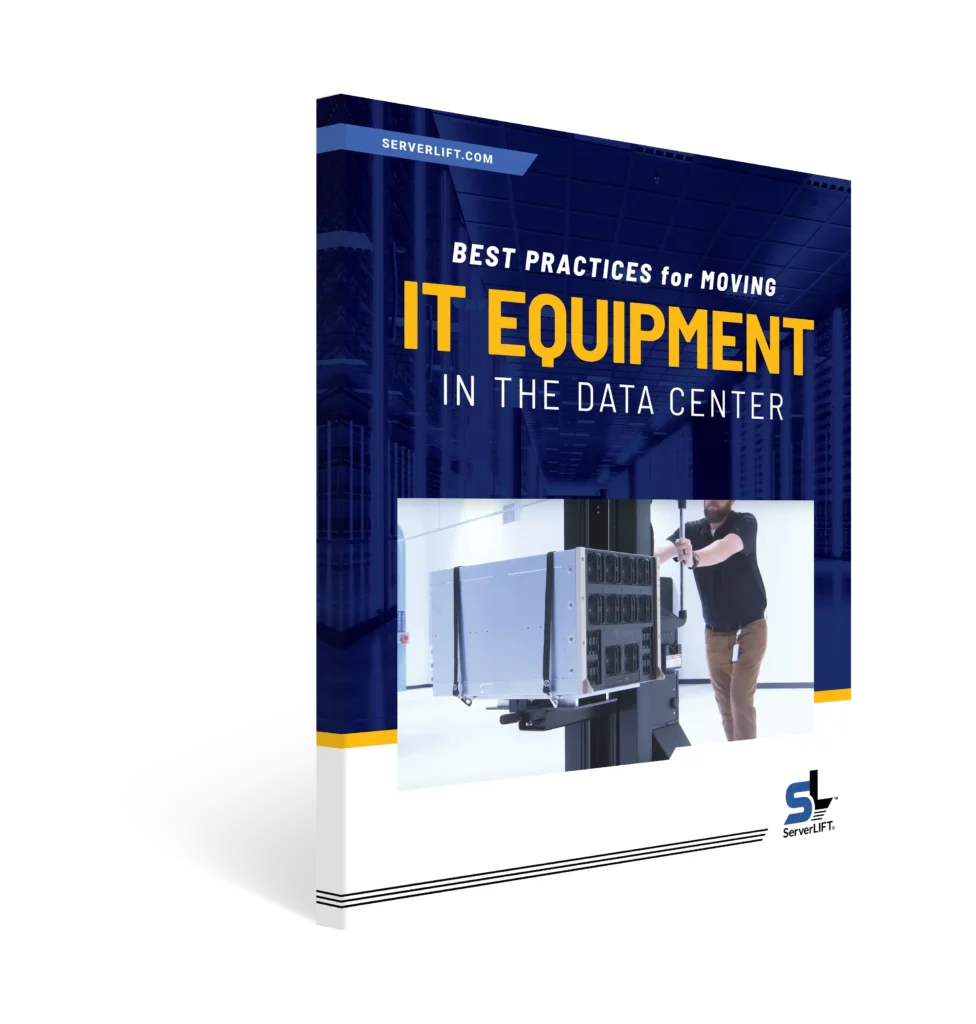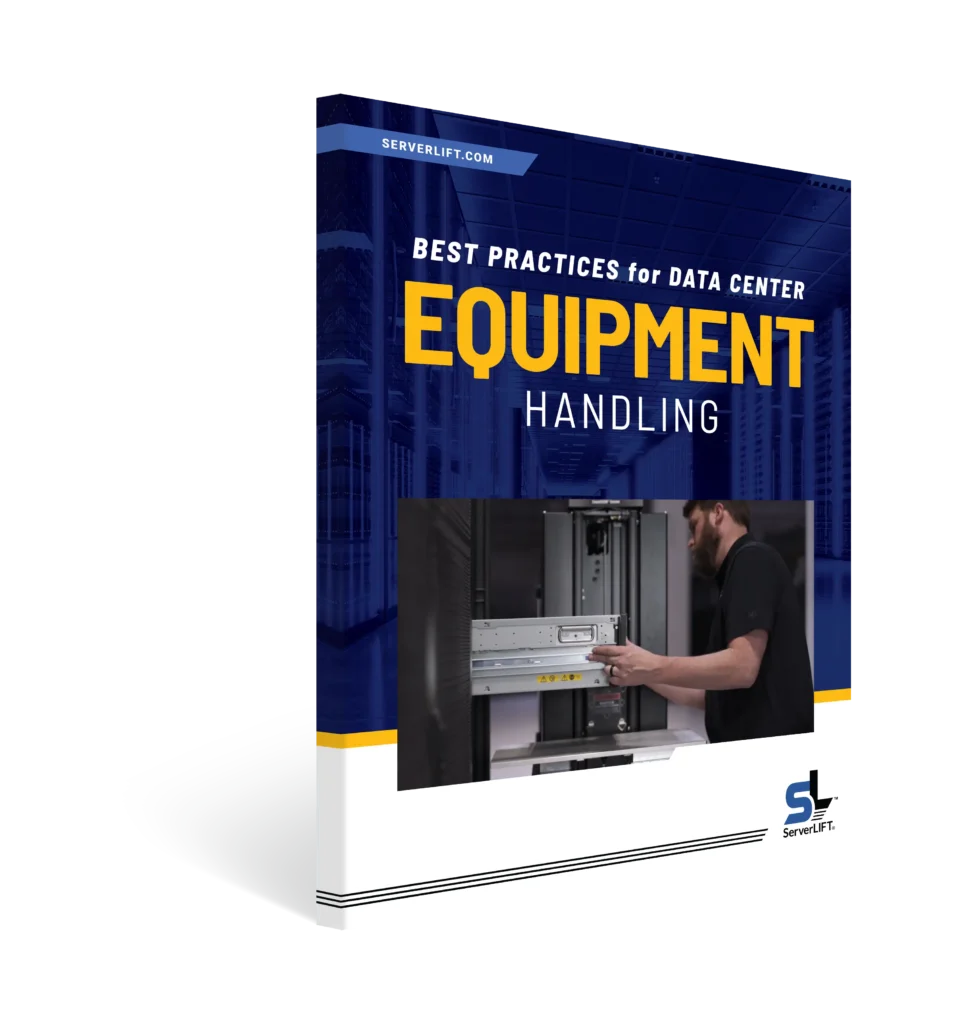

Ever wondered what the Occupational Safety and Health Administration (OSHA) secretly thinks when they tour your data center? You’re not alone. Because ServerLIFT® data center lifts are designed with safety as the top priority, we receive many questions about safety hazards in data centers and how to mitigate the most significant risks.
Many people who work in data centers probably think of these questions at some point, but may never ask them. So we put together the following list of FAQs to help answer them.
1. What are the risks of manually lifting servers in a data center?
There are three primary risks that are bad enough in isolation, but are even worse when they occur together:
- Physical injuries:
Because IT equipment is heavy, especially with the influx of AI-capable servers, it’s not safe to lift it manually. Technicians have to get these units off the floor, up to the level of the rack (often overhead or in an awkward position), and then slide it into place, all without any slips or misalignments. Even if your team is well-practiced with these maneuvers, it’s only a matter of time until someone is injured. - Hardware damage:
When you drop a server, that’s that. There’s no hoping for the best. You’re looking at replacing hardware, conducting an investigation into what happened, dealing with unplanned downtime, and having some uncomfortable conversations with leadership. The average cost of dropping an enterprise server is in the tens of thousands of dollars, and that’s before you factor in downtime. - Compliance exposure:
OSHA’s General Duty Clause requires employers to address recognized hazards. They’re clear that lifting heavy, expensive IT equipment in confined spaces constitutes a safety hazard. So if an incident occurs on your watch and you haven’t been following the established standards, you’re likely to face regulatory hurdles before you can continue operating.
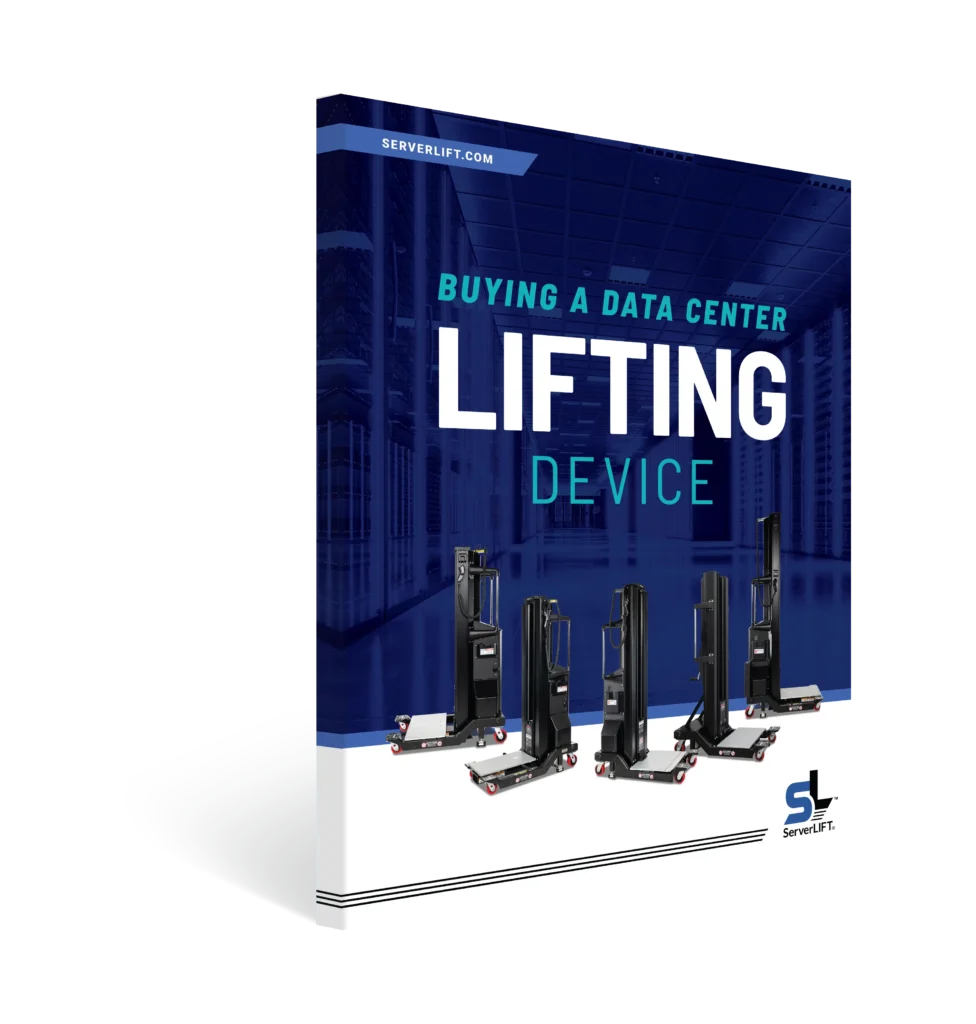
The fix for all of these problems is simple: use an industry-standard ServerLIFT® data center lift and stop lifting heavy items manually.
2. Why do data center workers continue to lift servers manually if the risks are this clear?
We ask ourselves that every day. But that’s because we also frequently see the repercussions when companies have mishaps. If you work in a data center that hasn’t had a problem yet, it’s easy to underestimate how bad an accident can be.
In short, data center workers continue to lift hardware manually for the same reason people skip wearing their helmets or seatbelts. Nothing bad has happened yet. So the inconvenience of taking safety precautions wins out over foresight. People tend to stick with familiar habits and assumptions until something upends their worldview.
6. What are the six non-negotiables in a safe data center lift?
Speaking of data-center-specific features, if your current lift lacks any of the following non-negotiables, purchase a ServerLIFT® data center lift instead. Our data center lifts meet these criteria:
- Stability under load:
No tipping or shifting on raised floor panels, uneven surfaces, or during transport. - Micro-level positioning:
Fine-tuned alignment control measured in fractions of an inch. - Smooth lift control:
Zero jerky or wobbly motions, even under heavy loads. - Rated weight capacity:
Our stated weight limits are for real-world conditions, not theoretical maximums devised in a lab. - Certified design:
Each ServerLIFT data center lift is UL, CE, FCC, and IC-certified. We do not “self-certify” or use any “equivalent to” marketing. - Single-operator usability:
When one person controls the entire operation, you can eliminate many human variables that cause mishaps.
7. How does the ROI on a ServerLIFT® data center lift actually calculate out?
For instance, you’ll no longer need to worry about:
- Injuries:
One serious musculoskeletal injury can cost more than a ServerLIFT® data center lift. Add OSHA recordables, insurance impact, and retraining, and the math isn’t even close. - Labor inefficiencies:
A single-operator installation replaces a two-to-four-person team. Multiply that labor reduction across a full deployment cycle, and the savings compound quickly. - Hardware damage:
Dropping servers entails replacement costs, downtime, data recovery, and root-cause investigation. Using an industry-standard ServerLIFT® data center lift eliminates the primary cause of drops.
9. What should data center ops leads do right now?
Take a walk through your facility and ask yourself:
- Are technicians lifting servers manually at any point during installation?
- Does racking equipment require more than one person?
- Is any lift currently in use not specifically designed for data center environments?
If even one answer is a “yes,” you have a documented safety gap and a quantifiable operational inefficiency you need to correct. All of this can be solved with one investment.
Take steps today to avoid problems tomorrow.
Instead of waiting for a team to drop a server and for one of your workers to suffer a life-changing injury, اتصل بنا. We’ll help you find the dedicated server handling solution that best fits your data center environment. We hope to hear from you soon! Stay safe out there.