
AI has reshaped the modern data center. In response, a new class of cloud provider has emerged: the neocloud.
These GPU-first platforms deliver intense accelerators, high-bandwidth fabrics, and fast deployment of pre-integrated AI racks. Examples include CoreWeave, Lambda, Voltage Park, en Crusoe.
These businesses prioritize time-to-compute above all other metrics, rather than general-purpose infrastructure as a service (IaaS). The hardware they use doesn’t resemble traditional server farms. Instead, they host 6U and 8U GPU servers (occupying 6 or 8 rack units of vertical space in a standard data center rack, respectively), weighing 200 to 300 pounds each, in meter-deep chassis and rack-scale systems that ship pre-assembled and are ready for liquid cooling.
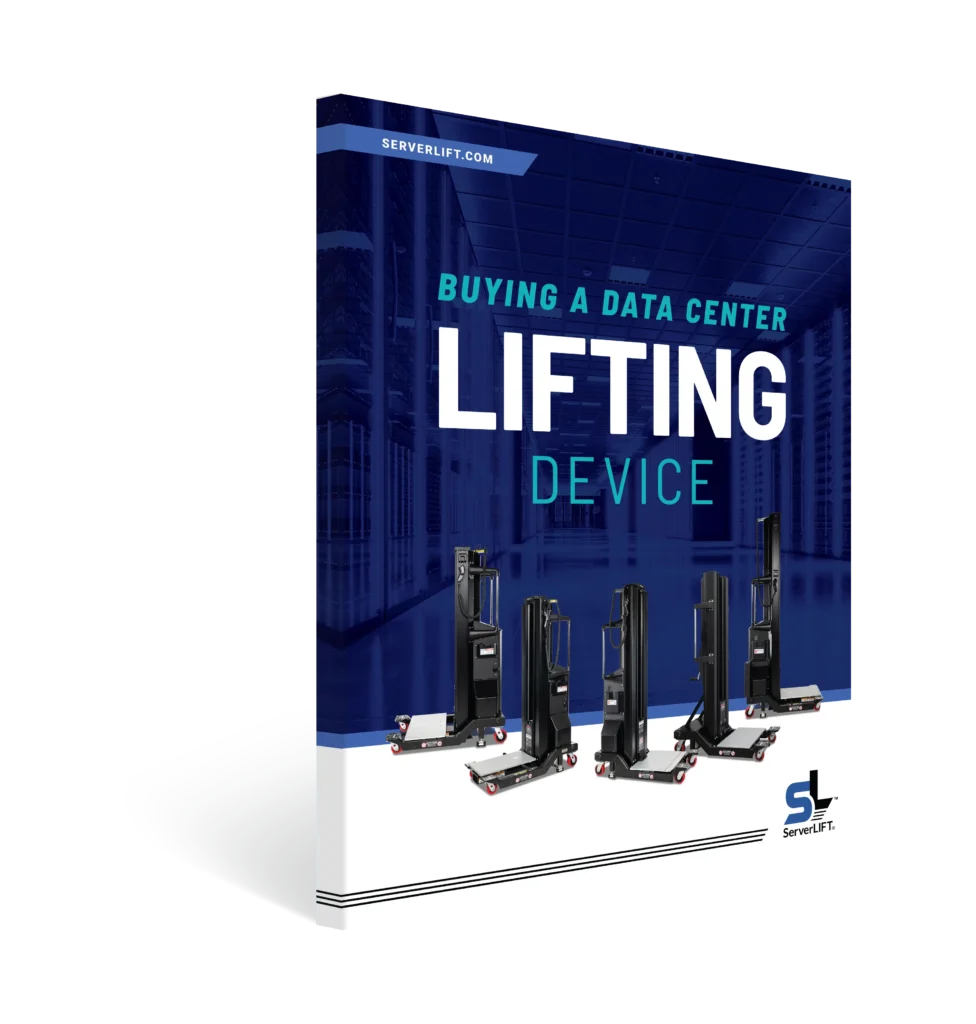
Such large, heavy IT equipment setups require proper lifting devices. Using the right type of IT equipment lift in a neocloud data center ensures worker safety and protection of expensive equipment.
Below are six key facets data center managers should be aware of when planning, building, or maintaining a neocloud site.
1. The Neocloud Provider Purpose and Operating Model
Neocloud providers sell ultra-dense compute clusters optimized for AI workloads as soon as capacity is available.
Each accelerator generation requires rapid turnover of entire racks, new liquid cooling loops, and upgraded interconnect fabrics. Clusters expand, upgrades occur regularly, and networks grow to accommodate traffic increases.
Safe handling of heavy IT equipment is a critical part of daily operations because infrastructure changes constantly. Lift capacity, aisle clearances, power, cooling, fabric design, installation protocols, and other constraints must be at the forefront of planning because operators will frequently refer to this plan.
2. Compute: Heavy GPU Servers and Rack-Scale Systems
Neocloud computing revolves around multi-GPU nodes and rack-scale GPU systems. Here are some equipment examples illustrating why it’s important to have purpose-built data center lifts that allow for precise handling and alignment:
- NVIDIA DGX H100/H200: 8U node. The maximum system weight is 287.6 pounds (130.46 kilograms). Depth is 35.3 inches (896.62 mm).
- Dell PowerEdge XE9680: 6U node. The maximum system weight is up to 251.44 pounds (114.05 kilograms) with a bezel depth of approximately 39.7 inches (982.98 mm). The weight ranges for H100/H200 builds are 237 to 250 pounds (107.51 to 113.4 kilograms). The depth remains near 39.7 inches (1000 mm), which complicates rail alignment without precise control.
- Rack-scale GPU platforms: CoreWeave deployments feature pre-integrated Blackwell-generation racks with 72 GPUs per rack, liquid cooling, and factory testing prior to shipment. These arrive as dense, serviceable assemblies that require data center lifts for precise positioning and on-site swaps.
If workers attempt to move, align, and install these types of systems without a purpose-built data center lift, they risk incurring injuries, including pinched fingers, wrenched backs, crushed hands, or worse.
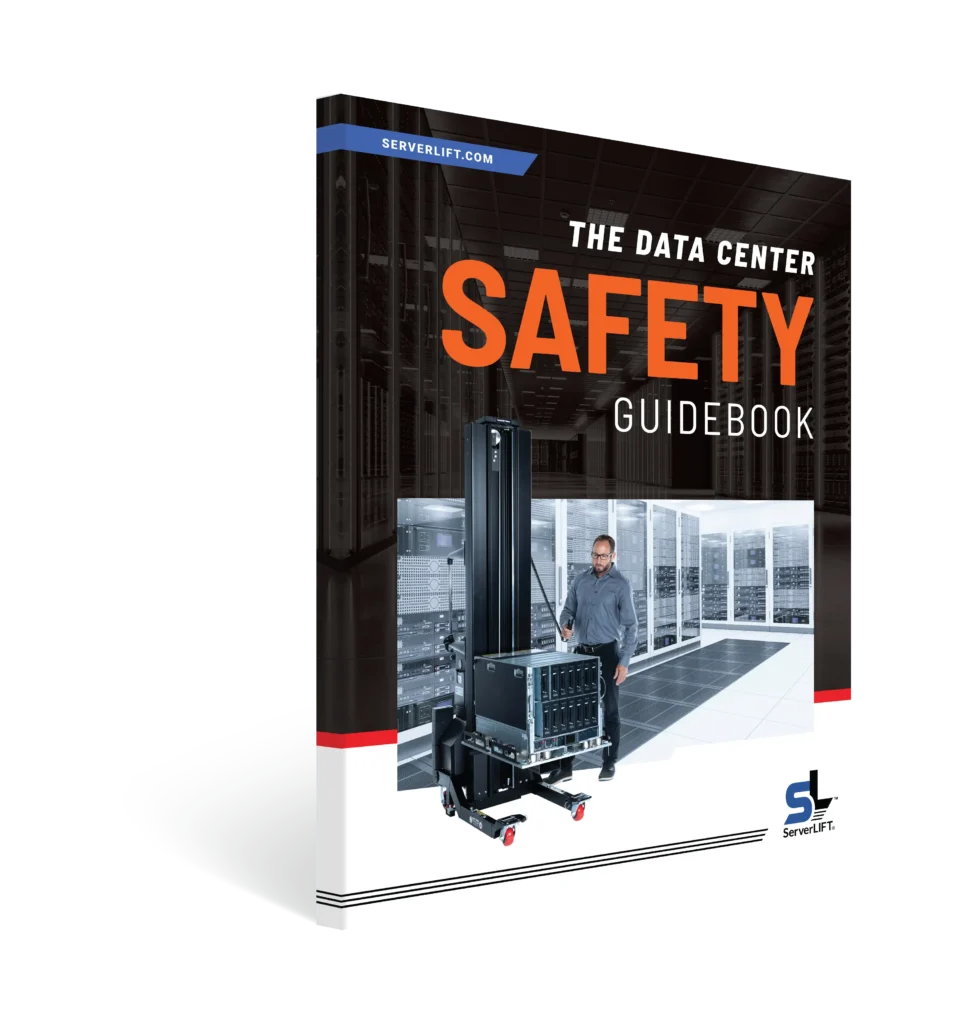
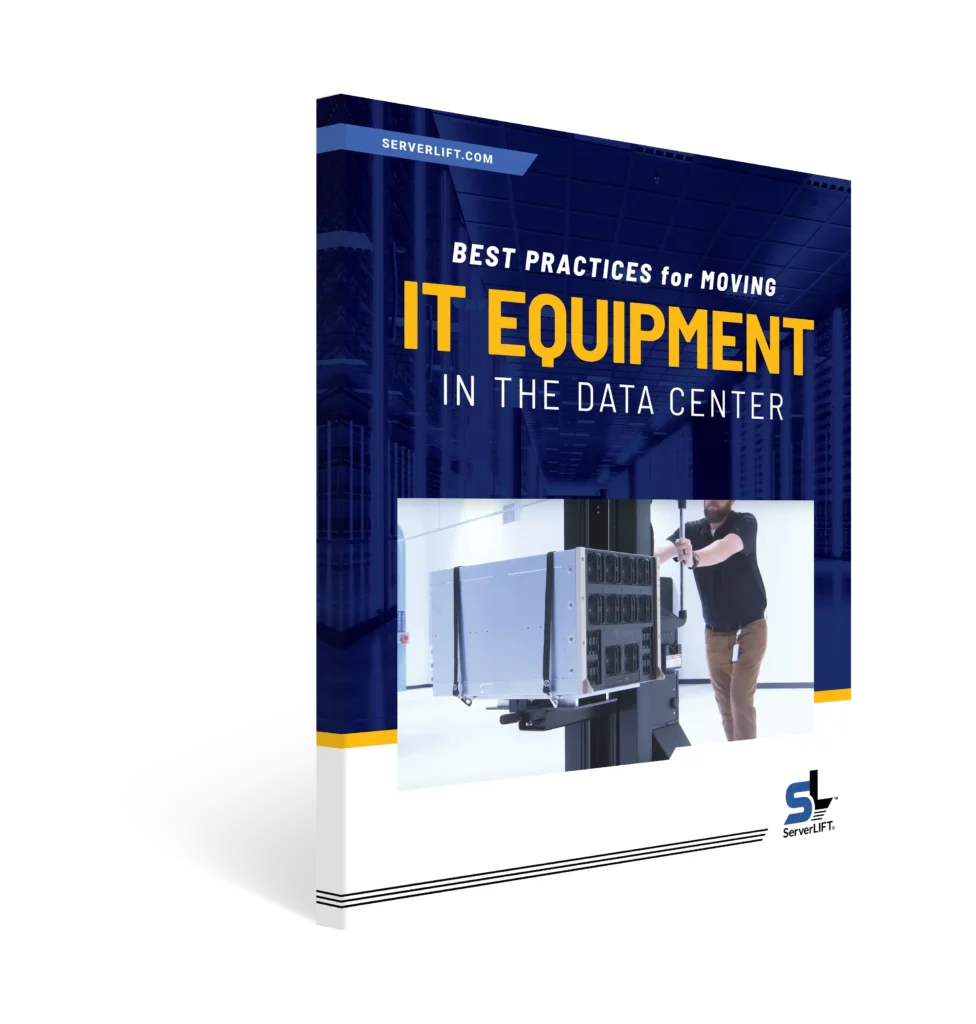
Just one person using a ServerLIFT data center lift can safely and efficiently move and install each of the above systems, make micro-adjustments to height and pitch for perfect rack alignment, and slide the whole payload smoothly onto the rails with no risk.
3. Networking: Modular Spine and Core Chassis
High-bandwidth fabrics require large, modular switch frames. The Arista 7812/7816 chassis, for example, weighs between 355 and 640 pounds (162 to 291 kilograms) when empty and exceeds 1,000 pounds (454 kilograms) when fully loaded.
Modular chassis introduce other unique handling challenges beyond sheer weight. For instance, technicians must insert fabric modules on high guide pins in tall, narrow frames, often above shoulder height. They also have to perform service at the front and rear of the chassis and thread modules past backplane connectors that are easily damaged by the smallest misalignments.
ServerLIFT data center lifts can stabilize a module’s weight and keep it parallel to the backplane. This prevents improper loads on guide pins and misalignment of connectors.
4. Storage: All-Flash Arrays and Dense Shelves
High-throughput AI pipelines require wide, deep, and dense storage components. For example, top-end arrays such as the NetApp AFF A900 can exceed 200 pounds (91 kilograms) per multi-U controller chassis.
The dense shelves often lead to awkward weight distributions. Front-loaded shelves can shift the center of gravity forward, making manual installations risky, even though the overall weight doesn’t seem significant. Off-balance loads above shoulder height are a recipe for disaster.
ServerLIFT data center lifts provide fine height control, which helps technicians align rail pins and avoid damaging components. The stable platform surface also supports the shelf evenly throughout the full range of motion.
5. Cooling at the Rack: Rear-Door Heat Exchangers and CDUs
Liquid cooling is non-negotiable for dense GPUs. Here are some handling distinctions:
- Rear-door heat exchangers (RDHx): Lenovo lists empty weights for 42U and 48U doors, ranging from 86 to 108 pounds (39 to 49 kilograms) before coolant is added. The hinge-mounted geometry is tall and off-center, and the final pin alignment happens at height.
- Active water-cooled rack doors: Vertiv’s Liebert DCD active doors weigh between 287 and 318 pounds (131 to 145 kilograms), depending on the model. Technicians handle these before the cooling loop gets wet. Misalignment during hinge-up can damage racks and door hardware.
Coolant distribution units (CDUs) can be at the rack or row level. Even the smaller rack CDUs are awkward to lift because of threaded hoses and finicky mount brackets. Facility CDUs roll on casters, but they still require careful placement, especially during the connection sequencing process.
A ServerLIFT purpose-built data center lift enables one technician to hold an RDHx square to the hinge while someone else sets the pins. The platform supports the full door weight. For CDUs and coil packs, the lift provides steady support during bracket mounting and hose routing, eliminating the need for risky manual balancing.
6. Power: UPS Frames, Battery Cabinets, and In-Rack Power
There is a wide range of weights for power components. UPS frames and battery cabinets can be very heavy. A purpose-built data center lift, such as the ones we manufacture at ServerLIFT, can often safely take these heavy components from the loading dock to the rack and back (in other words, the entire journey from unpacking to installation). Workers and power components stay safe with just one lifting solution. It’s a win all the way around.
A Practical IT Equipment Handling Plan for Neocloud Sites
Putting all this together, we can now determine a safe and practical protocol for lifting and moving neocloud IT equipment.
1. Map out the specifications for each rack’s heavy equipment.
Create a simple table for each cabinet that lists the RU, depth, dry weight, center of gravity notes, cable manager type, and installation order.
2. Include a safe margin for lift capacity.
Use a data center lift with a weight capacity that exceeds the weight of your single heaviest in-rack item.
3. Stage loading by depth and stiffness.
Load deep chassis and front-heavy shelves first. Keep the data center lift platform level unless the rail specification calls for pitch. Avoid prying actions that twist posts or rails.
4. Respect hinge and keep-out geometry.
RDHx doors need clear swing arcs. Mark the floor for hinge pin stations. Support the RDHx door gently and stably with the lift during hinge operations. Don’t use the lift to push, pry, or apply torque. Just keep the door steady.
5. Install wet gear while dry.
Mount doors and CDUs before they are filled. Re-torque after pressure and temperature cycles. The mass and leverage change significantly once the coolant begins to flow.
Why A ServerLIFT Data Center Lift Pays For Itself
Veiligheid
At ServerLIFT, we prioritize safety above all else. Our purpose-built data center lifts can handle very heavy IT equipment. Workers are protected from crushed fingers, back strain, shoulder injuries, and other mishaps that can occur during manual lifts and installations.
Speed
A single operator can stage, align, and complete installations on deep 6U–8U nodes in minutes. The time saved scales with the rack number and equipment change frequency.
Kwaliteit
Rails, backplanes, and cable managers are all susceptible to damage when heavy components are manually placed. Our micro-adjustable data center lift platforms maintain stable loads, eliminating the risk of bent rails and cracked connectors.
Toegang
Our data center lifts also easily fit through narrow aisles, navigate floor obstacles, turn with tight clearances, and reach the top of racks without workers having to climb, reach, or strain for high installations.
Build a plan around these principles, and you won’t need to worry about worker injuries, expensive IT equipment damage, or other costly mishaps.
Contact ServerLIFT for the ideal data center lift solution tailored to your specific needs.